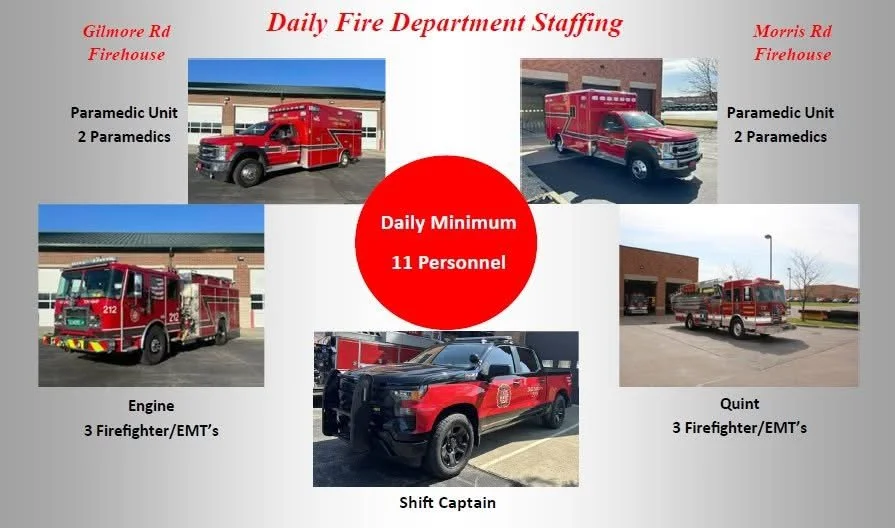
How many Firefighters are on Duty?
Have you ever wondered how many Firefighters are on duty at any given moment? Your Fairfield Township Fire Department staffs 2 firehouses with 11 personal. Those 2 firehouses are staffed 24 hours a day, 7 days a week, to provide fast and effective service.
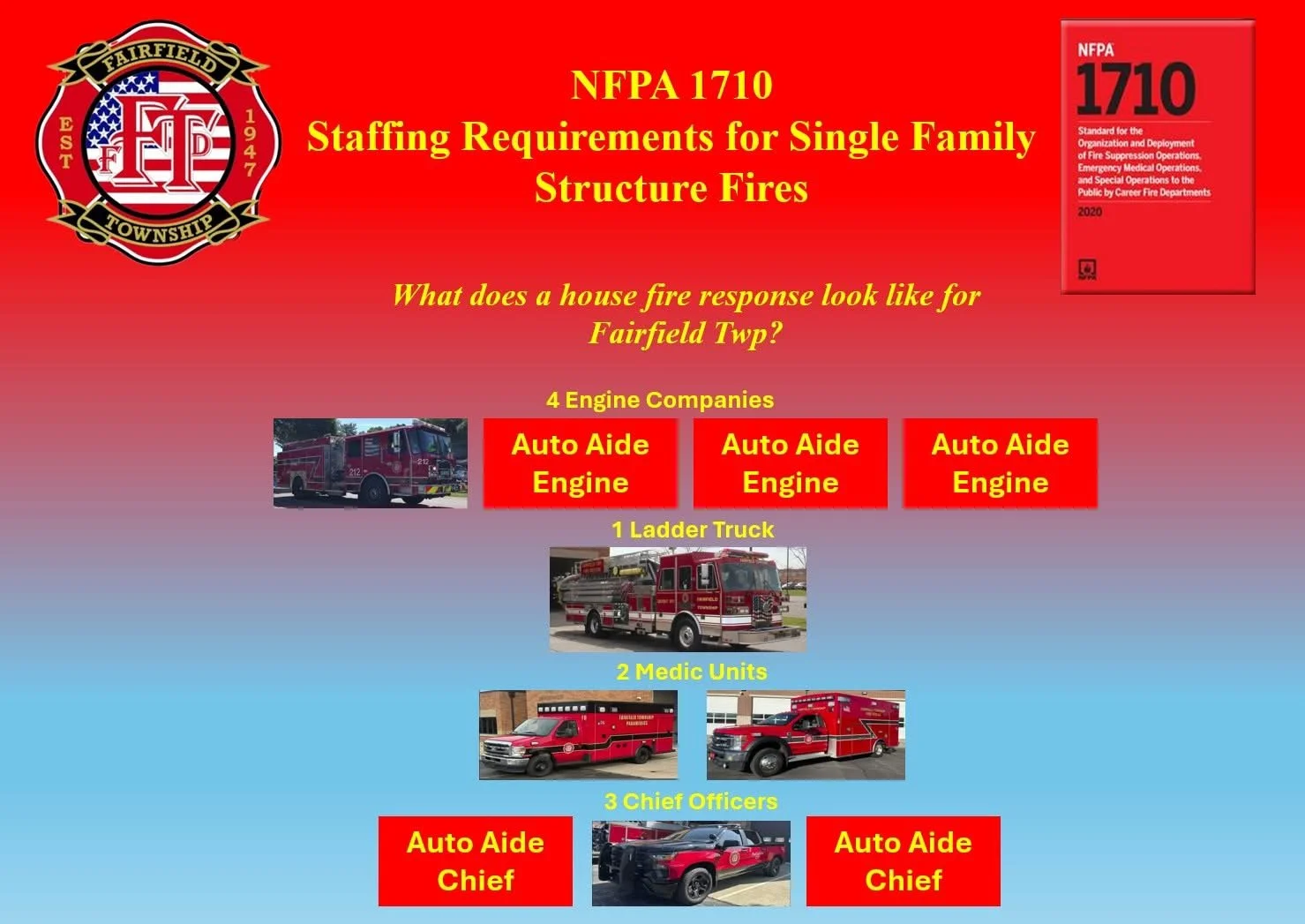
NFPA 1710 Staffing Requirements.
When a fire occurs in a home, the first few minutes are critical. NFPA 1710 is a nationally recognized standard that outlines recommended response times and staffing levels for career fire departments responding to a structure fire. This standard is 19 firefighters on scene within 8 minutes of the initial dispatch. This staffing allows firefighters to safely and efficiently perform multiple critical tasks at the same time, including; Fire Attack, Search and Rescue, Ventilation, Water Supplies, Incident Command and Firefighter Safety. Adequate staffing is imperative as it helps reduce fire spread, and improves rescue outcomes. Your Fairfield Township Fire Department currently staffs 11 personnel. This allows the 2 most critical tasks to be performed simultaneously, rescuing trapped occupants and extinguishing the fire. The remainder of the response comes from automatic mutual aide from surrounding communities.
Fire Department Staffing and Command Chain
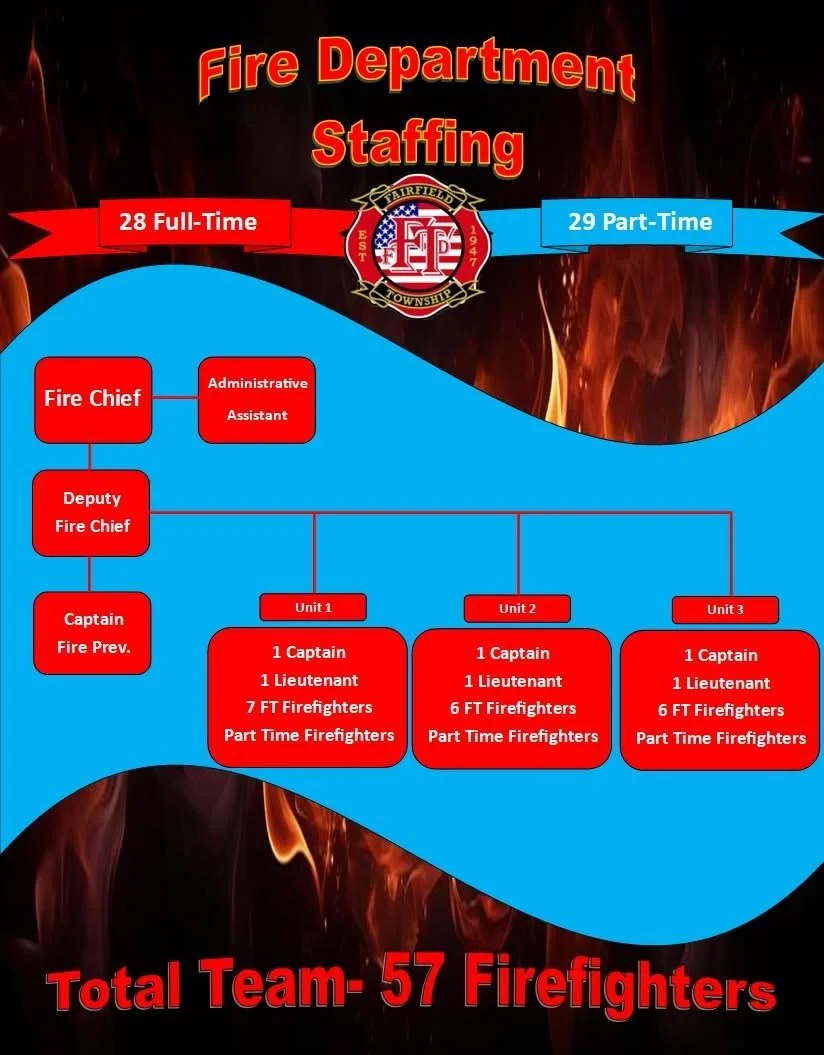
Your Fairfield Township Fire Department employs 28 Full Time Firefighters and 29 Part Time Firefighters. A Full Time Firefighter works a 24/48 schedule, averaging 50 hours per week. Full Time Firefighters receive benefits and contribute to the Ohio Police and Fire Pension system. A Part Time Firefighter works a variety of schedules such as 24 hours every 6 days, 12 hours every 3 days, or PRN (as needed). Part Time Firefighters receive no benefits and do not contribute to the pension system. Part Time Firefighters are limited in the total hours they can work per calendar year, and can’t exceed 1,500 hours. Many of our Part Time Firefighters work a Full Time job elsewhere. Until 2018 Fairfield Township was staffed entirely of Part Time Firefighters. As more Fire Departments added to their Full Time rosters, Part Time Firefighters became harder to find and rely on. Fairfield Township hired our first Full Time Firefighters in 2018, and over the past 8 years (as Part Time numbers worsened) more Full Time Firefighters were added. The infographic above provides the total number of Full Time and Part Time Firefighters currently employed and also provides and organizational chart outlining the positions within the Fire Department Today.
Fire Department Budget
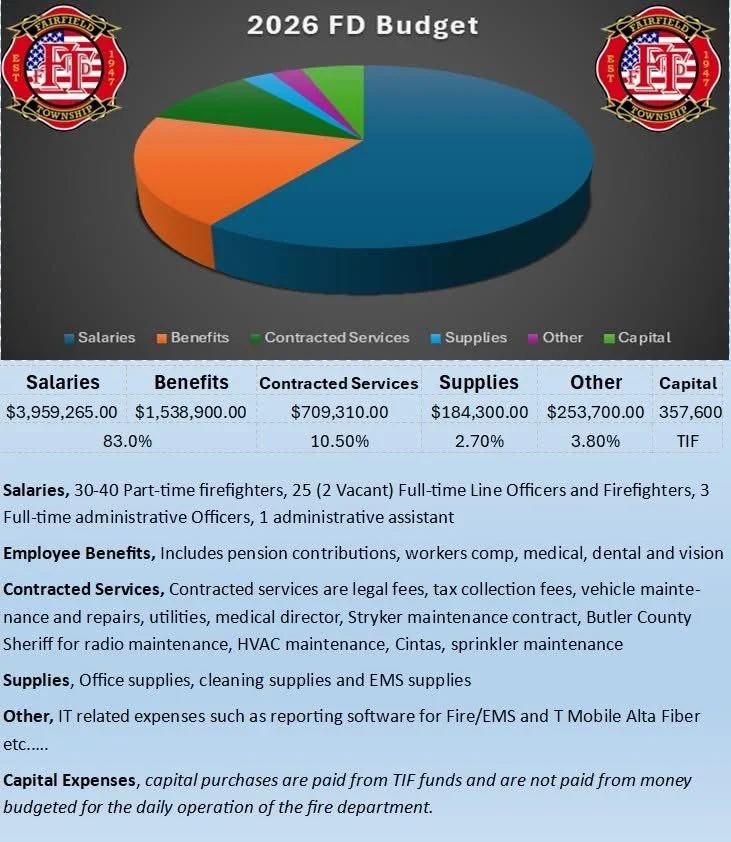
Understanding your Fairfield Township Fire Department Budget. When Fairfield Township Fire Department; responds to an emergency, trains for the next call, or maintains equipment, its all made possible by the communities investment. The Fairfield Township Board of Trustees have appropriated $6,492,700 for the operation of the Fire Department in 2026. With another $357,600 appropriated for capital expenditures. Our budget is made up of revenue from several different funds, a breakdown of these funds are as follows. 2008 fire levy- $2,428,500, 2016 Safety Service Levy- $800,000 (this levy is split 50/50 with the Police Department), EMS Billing- $945,000. All of these funding sources accumulate to $4,173,550. The remainder of our budget comes from other funds such as the General Fund, JEDD, and TIF.
Reliable funding ensures your Fairfield Township Fire Department can respond when seconds matter, protecting our firefighters, and providing the level of service you expect and deserve. The above infographic shows the breakdown of our 2026 budget, explaining what each area of the budget pays for.
Budget vs Revenue Historics
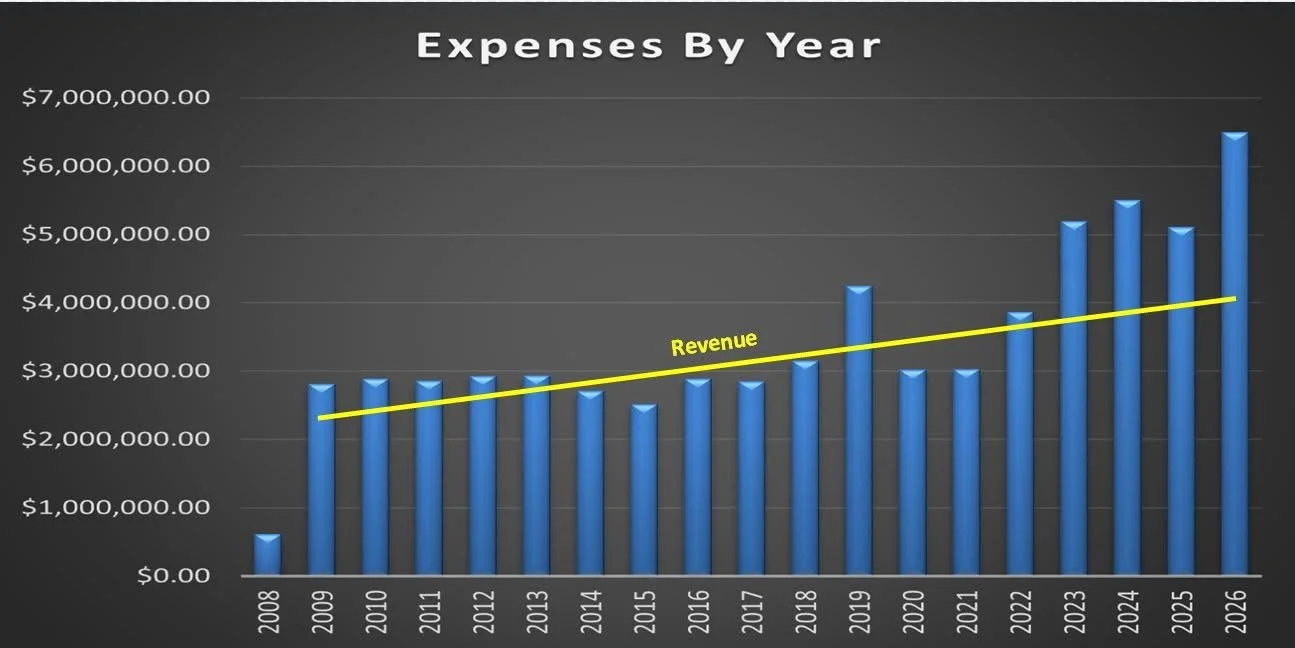
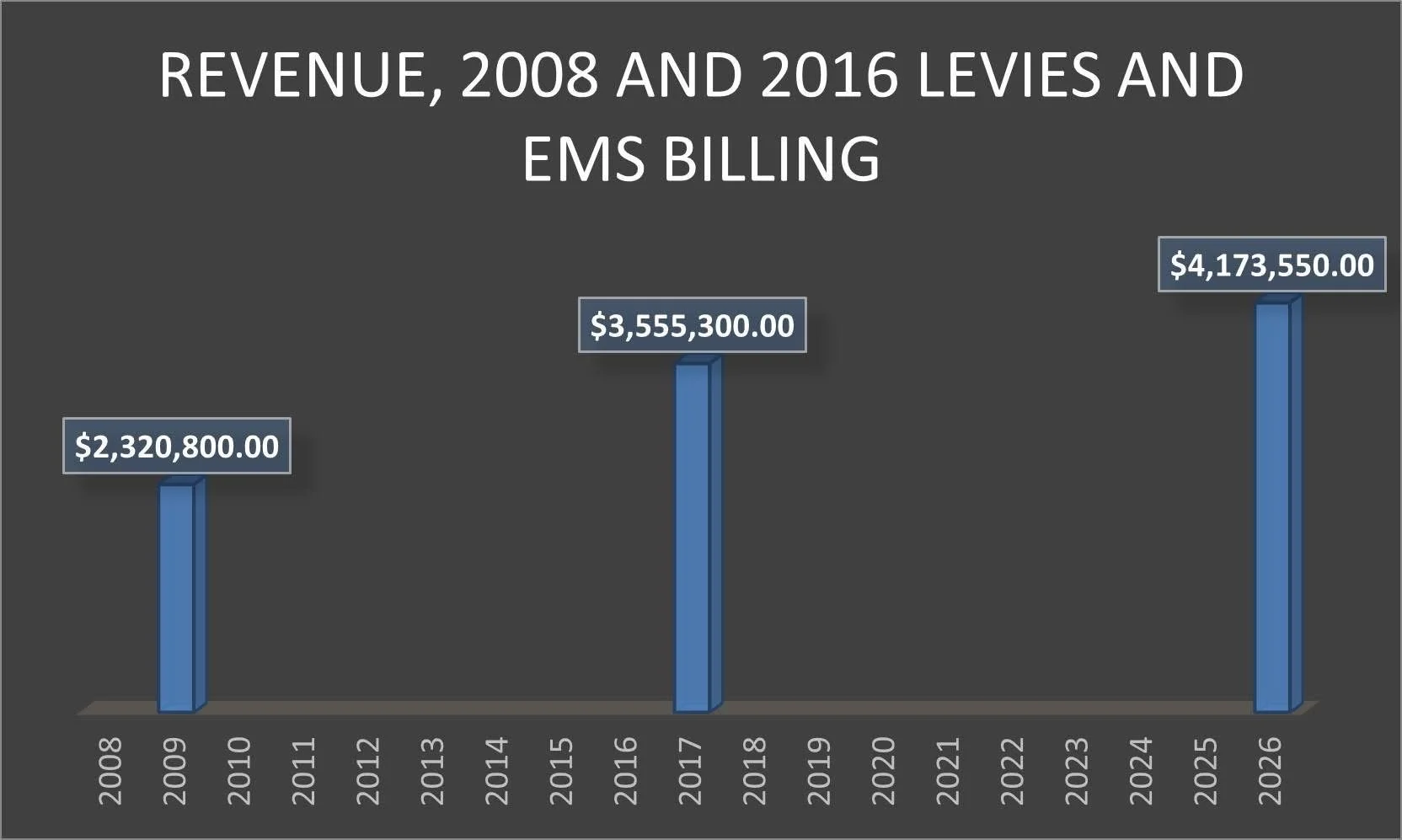
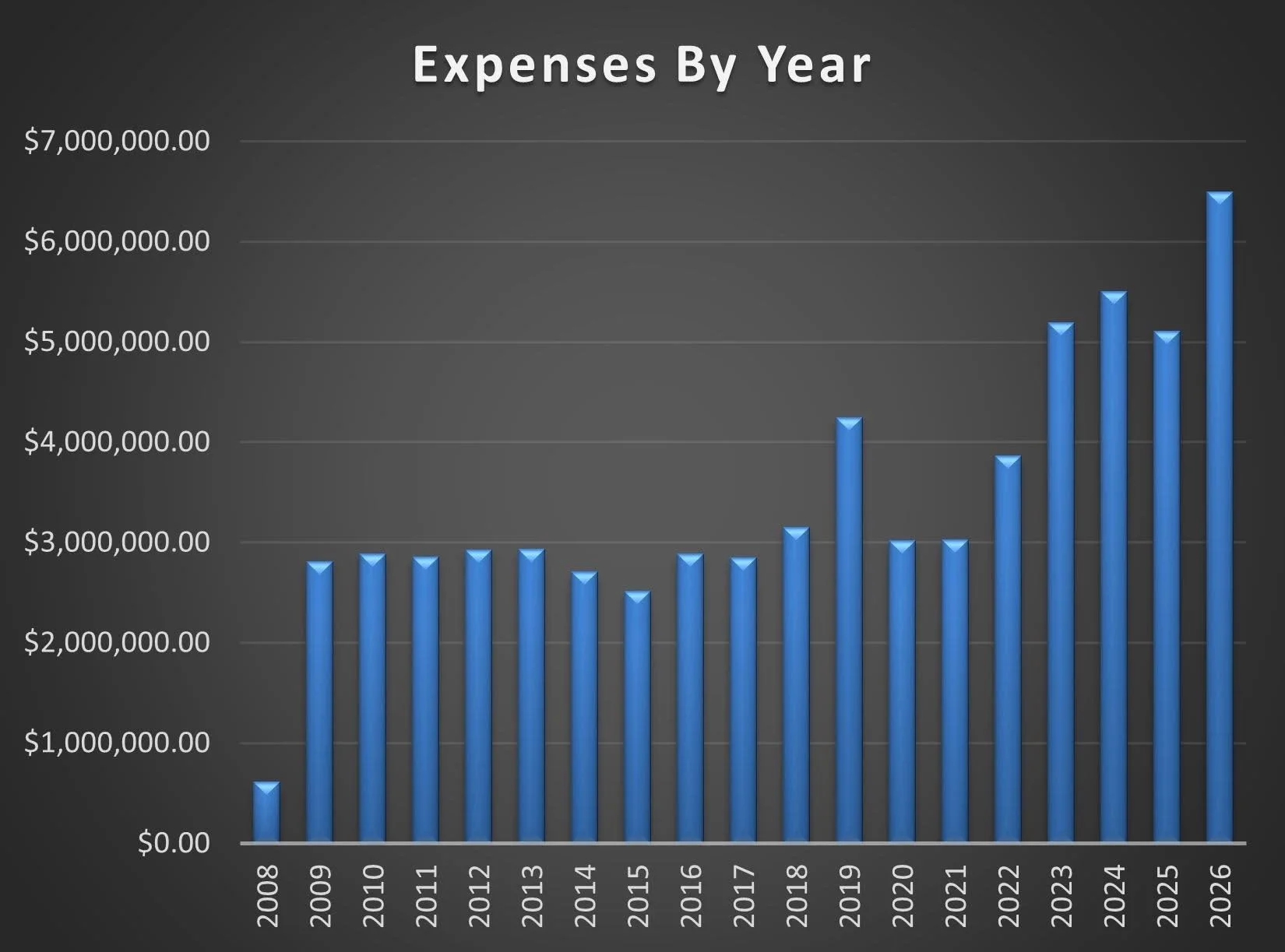
Previously, we broke down our budget. Here, we’ll look into the past to see what our budget and revenue have historically been. The Fire Department has an increase of only $800,000 over the past 18 years. This increase comes from the 2016 Safety Services Levy. 2026 is the first year the Safety Services Levy will be split 50/50 with the Police Department. We have also seen an increase in EMS billing each year, averaging 5-8% increases year to year. The 3 charts listed above show what the revenue looked like in 2009 and 2017, the first year each of our current levies began generating revenue. You can see that comparing 2009, 2017, and 2026, the Fire Department has seen a relatively flat revenue increase over the past 18 years. From 2009 to 2026 we saw and 80% increase in revenue while operating cost have increased 131%. From 2017 to 2026 we saw a 17% increase in revenue while operating cost have increased 128%.
Note: the drop in budget expenses in 2020 and 2021 was a result of federal CARES act money received as a result of the covid-19 pandemic.
Higher Cost to Maintain Service
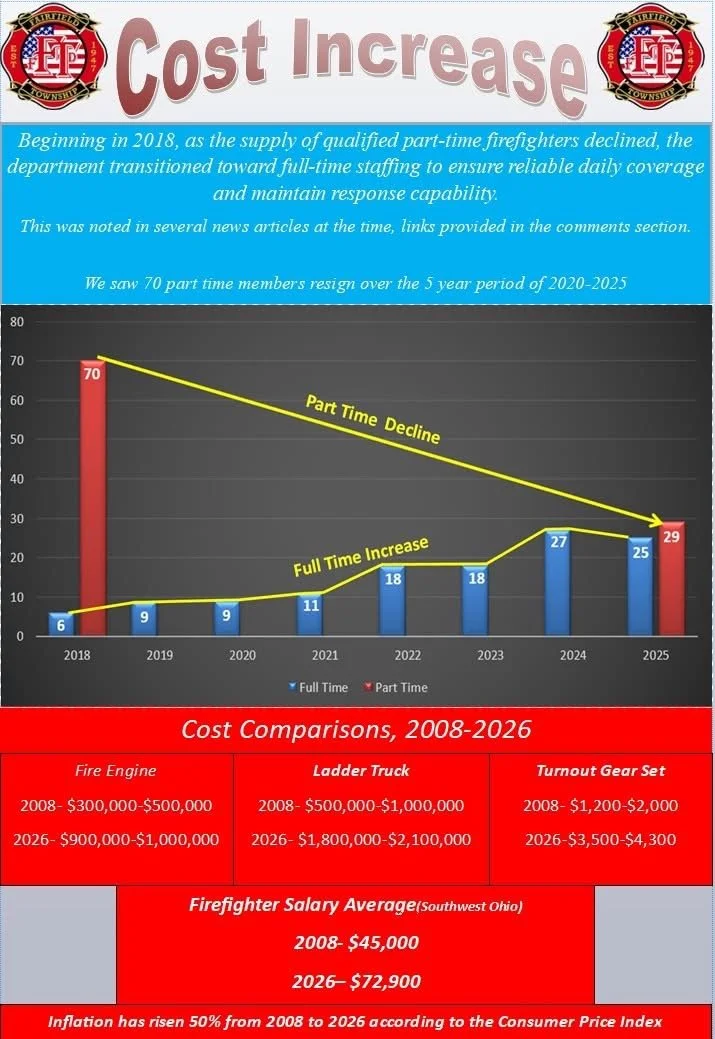
This next graph should explain the reasoning of the operating cost increase. Prior to 2018 the department was staffed entirely by Part Time Firefighters, who are paid hourly and do not receive benefits. Over time, the number of people applying for part time positions declined significantly. At the same time, emergency call volume increased from 2,884 in 2018 to 3,996 in 2025. Because we could no longer rely on part-time staffing alone to ensure crews were available, we began adding full-time firefighters. This was not an expansion of services, it was necessary to maintain reliable response times and the level of service residents expect, and deserve.
In addition, inflation has driven up the cost of nearly everything we use. Medical supplies, turnout gear, fuel, utilities, and maintenance, all cost significantly more. Even major purchases like fire engines and ambulances now cost hundreds of thousands more than what they did in the past.
These increases don’t create new services. They reflect the higher cost of providing the same emergency protection the community depends on.